

Trauma Therapy In Baltimore, Maryland
Virtual Services Available Throughout Maryland & Pennsylvania
Helping you move beyond survival toward greater safety, resilience, and connection with yourself and others.
Individualized Therapy That Honors Your Story

Healing begins when your story is met with safety, compassion, and understanding.
"I should be over this by now."
"Nothing is happening right now... so why does my body still feel on edge?"
"I don't recognize the person I've become."
"I keep waiting for something bad to happen."
"I'm exhausted, but I don't know how to slow down."
"Everyone says I'm handling it well. It doesn't feel that way."
"I know I'm safe, but my body doesn't seem to believe it."
"I've survived so much. I just don't want to keep surviving forever."
When It Feels Like Survival Never Really Ended
The people we work with are often the ones everyone else depends on. They've learned how to keep going through difficult experiences, push their own needs aside, and carry more than anyone realizes.
Eventually, though, surviving can start to feel like living. You may not understand why you're reacting the way you are, only that something doesn't feel like you anymore.
Sometimes recognizing yourself in these experiences is the first step toward healing.

If these thoughts feel familiar, you're in the right place.
Trauma Therapy In Baltimore, MD.
Virtual Services Available Throughout Maryland & Pennsylvania
Imagine a Life That Isn't Driven by Survival
When you've spent months or years in survival mode, it's easy to believe that always being on guard, expecting the worst, or feeling disconnected from yourself is simply who you are. Trauma therapy helps your mind and body recognize that what once kept you safe may no longer be serving you today.
Over time, many people notice meaningful changes, not because the past disappears, but because it no longer has to dictate the present. They begin sleeping more soundly, feeling less overwhelmed by everyday stress, responding instead of reacting, reconnecting with the people they love, and trusting themselves again.
Healing doesn't mean forgetting what you've been through. It means creating enough safety within yourself that your life is no longer organized around surviving.

You don't have to relive every detail to begin healing. We'll create a supportive environment where you can slow down, feel understood, and move at a pace that feels right for you.

Together, we'll understand the survival strategies that once protected you and begin building new ways of responding that better support the life you want today.

Healing isn't about forgetting the past. It's about feeling more grounded, connected, and able to respond to life with greater confidence and peace.

Trauma Specialized Care From Experienced Clinicians
Meet Your Trauma Therapists
Finding the right therapist matters. At Create & Connect, our trauma-informed therapists combine evidence-based approaches with genuine compassion to help you move beyond survival mode and toward meaningful, lasting healing.

-
Co-FounderCasey specializes in trauma therapy for first responders, service members, veterans, military spouses, and helping professionals. She integrates trauma-informed counseling, Internal Family Systems (IFS), and art therapy to help clients move beyond survival mode and reconnect with themselves.

-
Co-Founder
Chris specializes in trauma-informed care for adults navigating burnout, neurodivergence, identity, life transitions, and the emotional weight of high-responsibility roles. She combines art therapy with a culturally responsive, compassionate approach that honors each person's unique story.

What is Trauma?
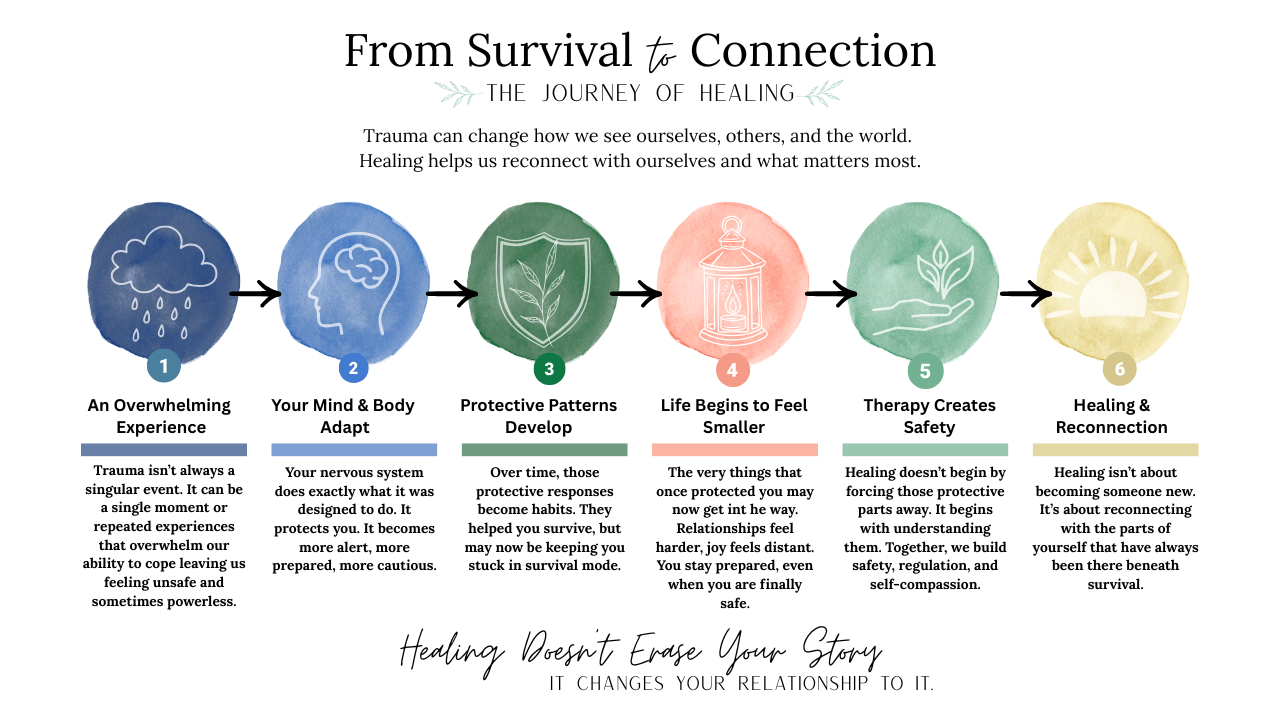
Trauma isn't defined by what happened. It's defined by how your mind and body continue responding to it.
Trauma isn't always a single life-threatening event. It can develop after one overwhelming experience or from repeated stress, chronic responsibility, loss, childhood experiences, military service, first responder work, medical trauma, or relationships that left you feeling unsafe.
When something feels overwhelming, your brain and nervous system shift into survival mode to help protect you. Those survival responses are incredibly adaptive during difficult moments, but sometimes they continue long after the danger has passed.
That's why you may know you're safe, yet still feel anxious, disconnected, constantly on guard, emotionally numb, or like you're always waiting for the next bad thing to happen.
Trauma isn't a sign of weakness. It's your nervous system doing exactly what it was designed to do. Healing helps your mind and body recognize when it's finally safe to let go of survival mode.

Understanding Trauma Through a Different Lens
Trauma isn't simply something that happened in the past.
It's the story of how your mind and body adapted in order to help you survive.
Many of the responses that feel frustrating today once served an important purpose!
-
Early experiences and Layers
When trauma happens in childhood or in ongoing environments where safety was uncertain, it can shape the way we see ourselves and relate to others. We approach complex trauma gently and collaboratively, helping you understand the protective parts that formed to keep you safe while fostering inner trust, self-compassion, and emotional regulation.
-
Carrying the Weight
First responders, healthcare workers, and helping professionals often experience repeated exposure to distressing events. Over time, this can lead to emotional numbness, hypervigilance, or burnout. With extensive experience supporting these populations, we offer a space where you can unpack your experiences, build resilience, and reconnect with your sense of self beyond the uniform or role. -
When Safety and Connection Were Complicated
Sometimes trauma isn’t about what happened, but about what was missing: consistent care, safety, or emotional connection. We help you explore how past relational wounds may still influence your present relationships and self-view, guiding you toward healing and more secure ways of connecting with others and yourself. -
When Identity and Experience Intersect
Racial, ethnic, and cultural trauma can show up in subtle and overt ways through discrimination, microaggressions, systemic inequities, or the lasting impact of historical oppression. Therapy provides a safe space to explore how these experiences affect your sense of self, relationships, and emotional well-being. Casey and Chris offer culturally competent and compassionate support to help you process these wounds, reclaim your voice, and build resilience while honoring your heritage and identity. -
Healing the Patterns That Span Generations
Trauma doesn’t always stay with one person, it can ripple across families and generations, shaping beliefs, behaviors, and emotional responses. Whether it stems from family dynamics, historical events, or unresolved ancestral pain, intergenerational trauma can affect how we relate to ourselves and others. Casey and Chris provide compassionate guidance to help you uncover these patterns, understand their impact, and take intentional steps toward healing, growth, and self-compassion. -
When the Ground Beneath You Shifts
Loss, illness, betrayal, or sudden change can shake the foundation of what we once believed to be safe or certain. We create a space where you can process grief, honor what’s been lost, and begin to make meaning of your experience without pressure to “move on” before you’re ready.
Understanding Your Story

Trauma therapy looks different for every person because every healing journey is unique.
Trauma Doesn't Stay in the Past
It has a way of showing up in everyday moments.
Rest Feels Impossible
You fall asleep exhausted but wake up feeling like you never really rested. Your mind stays alert even when your body is begging for a break.
Small Things Feel Big
A loud noise, a simple disagreement, or an unexpected change can trigger a reaction that feels much bigger than the situation itself.
You Don't Feel Like Yourself
The things you used to enjoy don't feel the same anymore. You know you've changed—you just aren't sure how to find your way back.
Relationships Feel Different
You love the people around you, but you find yourself pulling away, becoming irritable, or struggling to explain what's happening inside.
You’re Functioning, But Barely
From the outside, you seem capable. Inside, you're exhausted from holding everything together.
Your Brain Won't Slow Down
You're always thinking ahead, preparing for the worst, replaying conversations, or scanning for what could go wrong next.
Learn More About Our Approach to Trauma Therapy

“Once you start approaching your body with curiosity rather than fear, everything shifts.”
— Bessel van der Kolk, M.D., The Body Keeps the Score
The body can continue to hold the effects of experiences long after the event has passed.
Together, we create space for curiosity, safety, and healing, so you can reconnect with yourself in meaningful ways.


-
Trauma isn't defined solely by what happened to you, it's also about how your mind and body responded to the experience. While many people associate trauma with major events like combat, accidents, or natural disasters, trauma can also result from ongoing experiences such as childhood neglect, emotional abuse, relationship difficulties, chronic stress, discrimination, medical experiences, or repeated exposure to distressing situations.
You may notice trauma showing up as feeling constantly on edge, avoiding certain people or places, difficulty trusting others, emotional numbness, nightmares, heightened anxiety, or feeling as though you're always waiting for something bad to happen. Some people become highly independent or perfectionistic, while others feel disconnected from themselves or struggle to regulate emotions.
Not everyone who experiences trauma develops PTSD, and no two people respond to difficult experiences in exactly the same way. If your past continues to affect your relationships, daily life, sense of safety, or overall well-being, therapy can help you better understand those experiences and begin moving toward healing. You don't need to determine whether your experiences were "traumatic enough" before reaching out for support.
-
This is much more common than many people realize. Trauma can affect how memories are stored and recalled, particularly when experiences were overwhelming or occurred during childhood. It's not unusual for memories to feel fragmented, incomplete, or difficult to access.
Trauma therapy is never about forcing memories or trying to recover details you don't remember. Instead, we focus on your present-day experiences, how your nervous system responds, what emotions or patterns you're noticing, and how your past may be influencing your life today.
Healing doesn't require remembering every detail. Our work is centered on helping you feel safer, more connected, and more empowered in the present, regardless of how much you remember about the past. We move at a pace that feels respectful of your comfort and readiness, allowing insight and healing to develop naturally over time.
-
Absolutely not.
One of the most common misconceptions about trauma therapy is that you'll be expected to immediately share every painful detail of your experiences. In reality, effective trauma therapy begins by establishing safety, trust, and a strong therapeutic relationship.
During the early stages of therapy, we often focus on understanding your current challenges, building coping skills, strengthening emotional regulation, and helping your nervous system feel more grounded. These foundations create a greater sense of stability before exploring more difficult experiences, if and when you're ready.
You remain in control of what you share and when you share it. There is never pressure to disclose anything before you feel comfortable. Healing happens through a collaborative process, and your pace will always be respected.
-
There isn't a single timeline for healing because every person's experiences, goals, and needs are different.
Some individuals benefit from short-term therapy focused on developing coping skills, managing symptoms, or navigating a recent difficult event. Others find longer-term therapy helpful for processing complex trauma, childhood experiences, or long-standing patterns that have developed over many years.
Rather than measuring success by how quickly therapy ends, we focus on meaningful progress. Throughout therapy, we'll regularly revisit your goals, celebrate growth, and adjust your treatment plan as your needs evolve.
Healing isn't about rushing the process, it's about creating lasting change in a way that feels safe, sustainable, and supportive.
-
Yes. Research has shown that virtual therapy can be an effective way to treat trauma for many individuals, and many clients appreciate the comfort, convenience, and privacy of participating from their own homes.
For some people, being in a familiar environment actually helps them feel more regulated and emotionally safe during therapy. Virtual sessions also eliminate travel time, increase flexibility, and make it easier to access specialized trauma-informed care, particularly if local providers are limited.
During online trauma therapy, we use the same evidence-based principles as we would in person, including building a trusting therapeutic relationship, developing coping skills, supporting nervous system regulation, and processing experiences at a pace that feels safe.
Whether you're located in Maryland or Pennsylvania, our goal is to create a secure, compassionate virtual space where healing can happen one step at a time.
-
Many people begin trauma therapy wondering if they'll ever feel "normal" again. While healing looks different for everyone, recovery is absolutely possible. Therapy isn't about erasing your past or pretending difficult experiences never happened. Instead, it's about helping you reconnect with the parts of yourself that may have felt lost beneath fear, survival, or chronic stress. Over time, many people notice increased emotional flexibility, stronger relationships, greater self-compassion, and a renewed sense of safety and purpose. Healing isn't about becoming someone new, it's about rediscovering the parts of yourself that trauma may have overshadowed
Frequently Asked Questions

Healing Begins With One Conversation.
Trauma Therapy and Art Therapy Services In Baltimore MD.
Virtual Services Available Throughout Maryland & Pennsylvania
If you're wondering whether trauma therapy is right for you, we'd be honored to connect. Schedule a complimentary 15-minute consultation to ask questions, learn more about our approach, and decide whether we're the right fit for your journey.